How to Identify and Trap an Opossum With a Cage Trap and Backyard Baits Opossum Bait
You walk outside in the morning and discover that something has been working its way through your backyard during the night.
The garbage has been disturbed.
The pet food is gone.
The garden or flower bed has been scratched up.
Maybe you find a few shallow holes in the soil or discover that something has been digging around the base of your trees and shrubs.
You didn’t see anything.
But something was definitely there.
If this happens repeatedly after dark, an opossum may be the culprit.
Opossums are highly adaptable nighttime visitors. They are excellent scavengers and will take advantage of almost any easy food source they can find around a home.
The good news is that if an opossum has become a nuisance, a properly positioned cage trap can be an effective way to remove the animal.
The key is understanding one simple principle:
Don’t trap where you found the mess. Trap where the opossum travels.
First, Make Sure It’s an Opossum
Before setting your trap, identify the animal responsible for the activity.
Opossums can be confused with raccoons, skunks, and other nocturnal wildlife because many of these animals are active at night and attracted to similar food sources.
However, there are several clues you can look for.
Look for Five-Toed Tracks
Opossums have five toes on each foot.
The hind foot is particularly distinctive because the inner toe functions somewhat like a thumb, which can make the track look unusual.
Look for tracks around:
- Muddy areas
- Soft garden soil
- Garbage cans
- Buildings
- Decks
- Pet-feeding areas
Tracks aren’t always easy to find, but when you do find them, they can be extremely useful for identifying the animal.
Look for Nighttime Disturbances
Opossums are primarily nocturnal.
That means your best evidence is often what you find in the morning.
Look for:
- Scattered garbage
- Disturbed compost
- Missing pet food
- Turned-over containers
- Digging in soft soil
- Disturbed mulch
- Tracks
- Droppings
If everything looks normal at sunset but something has been disturbed by sunrise, you’ve narrowed the list of suspects considerably.
Opossums Are Opportunistic Feeders
An opossum isn’t necessarily coming to your property because it has decided to live in your backyard.
It may simply have discovered an easy meal.
Opossums eat a wide variety of foods and are opportunistic feeders.
Their food may include insects, fruit, carrion, food scraps, and other available sources.
Around homes, they may be attracted by:
- Pet food
- Garbage
- Compost
- Fallen fruit
- Birdseed
- Food scraps
- Insects
- Other easily accessible food
This is important because food availability affects where you should put your trap.
Find Where the Opossum Is Traveling
Before setting the trap, take a look around the property.
Ask yourself:
- Where is the opossum coming from?
- Where is it going?
- Where is it finding food?
Opossums often use protected edges and routes around structures and landscaping.
Look for travel corridors along:
- Fences
- Buildings
- Decks
- Porches
- Wood lines
- Brush
- Retaining walls
- Creeks or drainage areas
If you can identify a route that the animal repeatedly uses, you’ve found a much better trapping location than simply placing a cage in the middle of the yard.
Look for Shelter
Opossums don’t need an elaborate den.
They may use sheltered locations such as:
- Areas under decks
- Areas beneath porches
- Areas under sheds
- Brush piles
- Woodpiles
- Hollow trees
- Crawl spaces
- Gaps around structures
If you’ve discovered that an opossum is using a particular area for shelter, don’t immediately seal the opening.
First, make certain there isn’t an animal—or dependent young—inside.
Once you’re certain the area is vacant, appropriate exclusion work can help prevent future problems.
Choosing the Right Cage Trap
Use a sturdy cage trap large enough for an opossum.
The trap should have a reliable trigger mechanism and enough room for the animal to enter comfortably.
Before setting the trap, test it.
Make sure:
- The door closes properly
- The trigger works reliably
- The trap sits level
- The trap doesn’t rock or wobble
- There are no sharp or damaged wires
- The animal cannot easily push or tip the trap
A stable trap is a better trap.
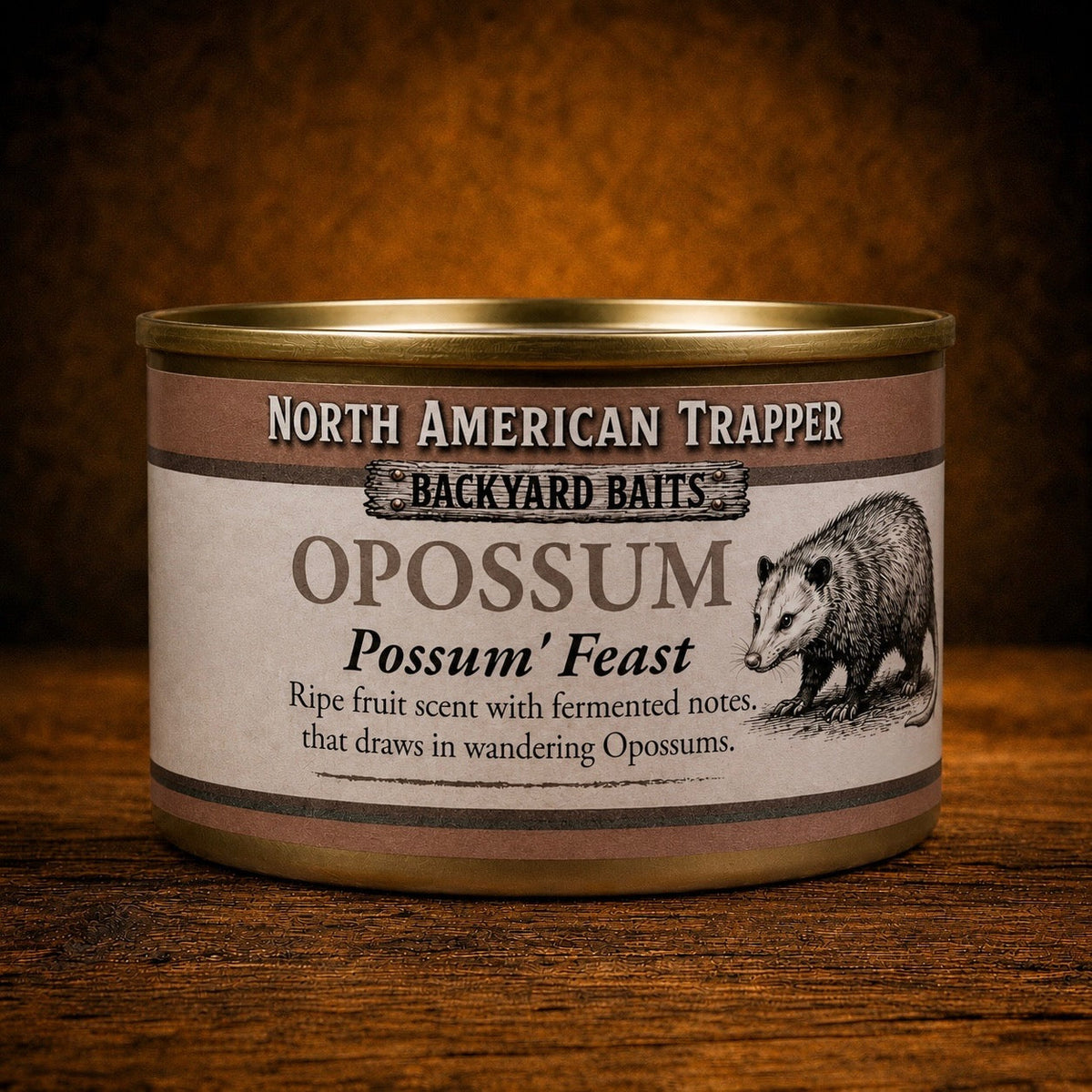
Using Backyard Baits Opossum Bait
Now that you have the trap in the right location, it’s time to give the opossum a reason to enter.
Place Backyard Baits Opossum Bait toward the back of the cage trap, beyond the trigger.
You want the opossum to walk completely into the trap to reach the bait.
Don’t put the bait directly at the entrance.
Make the animal commit to entering.
That’s the basic principle behind successful cage trapping:
The animal should have to go to the bait, not simply smell it from outside the trap.
Where Should You Put the Trap?
Trap placement is critical.
If the opossum is coming into your yard from a wooded area and heading toward your garbage cans, don’t necessarily put the trap beside the garbage.
Instead, look for the route the animal uses to get there.
Along a Fence
Fence lines can provide a natural travel corridor.
Beside a Building
Opossums often travel close to structures rather than crossing wide-open spaces.
Along a Brush Line
A brushy edge can provide cover as the animal moves.
Near a Food Source
If an opossum repeatedly visits a specific food source, the trap can be positioned along its approach route.
Whenever possible, remove or secure competing food sources.
Make the Trap Comfortable to Enter
An opossum is low to the ground and should be able to walk naturally into the cage.
Set the trap level with the surrounding ground.
If there is a large gap underneath the cage, use appropriate natural material around the base to make the trap more secure and eliminate obvious openings.
Don’t bury the trap.
Don’t create a complicated obstacle course.
The goal is simply to make the cage look like a natural object that the opossum can easily enter.
A Simple Opossum Cage-Trapping Setup
Step 1: Identify the Animal
Look for nighttime activity, five-toed tracks, and scavenging damage.
Step 2: Find the Food Source
Determine what is attracting the opossum.
Step 3: Find the Shelter
Look for protected areas where the animal may be spending the daylight hours.
Step 4: Find the Travel Route
Look for the path between shelter and food.
Step 5: Select a Sturdy Cage Trap
Choose a properly sized trap with a reliable door and trigger mechanism.
Step 6: Position the Trap
Place the trap directly along the opossum’s established travel route.
Step 7: Add Backyard Baits Opossum Bait
Place the bait beyond the trigger so the opossum must enter the cage to reach it.
Step 8: Stabilize the Trap
Make sure the trap is level, stable, and secure.
Step 9: Remove Competing Food Sources
Remove or secure other easily accessible food sources whenever practical.
Step 10: Check the Trap Frequently
Monitor the trap regularly and follow all applicable trapping and wildlife regulations.
What If the Opossum Walks Around the Trap?
Don’t panic.
Don’t automatically assume that you need more bait.
Look at the location.
If the opossum is walking past the trap, that is valuable information.
You’ve learned where the animal is traveling.
Now ask:
Is the trap actually in its path?
Maybe the opossum is traveling two feet to one side.
Maybe it is approaching from another direction.
Maybe the cage is sitting in an exposed location.
Maybe there is an easier food source nearby.
Move the trap to match the animal’s behavior.
Let the animal show you where the trap belongs.
Pre-Baiting a Cage Trap
Some opossums will enter a cage trap readily.
Others may be more cautious.
If an opossum is avoiding the cage, pre-baiting can help.
Place bait in or around the trap while the trap is inactive, provided the trap’s design allows this to be done safely.
This allows the animal to investigate without being captured.
Once the opossum becomes comfortable visiting the bait, activate the trap according to the manufacturer’s instructions.
This isn’t always necessary.
If the animal is already actively investigating the cage and bait, you may not need the extra step.
Eliminate the Competition
If you’re trying to trap an opossum while leaving an all-you-can-eat buffet sitting 10 feet away, you’re making the job harder.
Secure:
- Garbage cans
- Pet food
- Compost
- Fallen fruit
- Food scraps
- Other accessible food
The objective isn’t to starve the animal.
It’s simply to eliminate easy alternatives and make your trap more attractive.
What Do You Do After You Catch the Opossum?
Know the law before you set the trap.
Wildlife trapping, transportation, and relocation regulations vary by state and local jurisdiction.
Don’t assume that a captured opossum can simply be transported somewhere else and released.
Some areas have restrictions concerning relocation, release locations, and the handling of nuisance wildlife.
Before trapping, determine what your local regulations allow.
If you’re uncertain about what to do with a captured animal, contact your state wildlife agency or a qualified nuisance-wildlife professional.
Keep children and pets away from the cage, and avoid unnecessary handling of the animal.
Don’t Forget the Reason It Came
Removing one opossum doesn’t necessarily make the property unattractive to the next one.
If your backyard continues to offer food and shelter, another animal may eventually discover the same opportunity.
After the immediate problem is resolved, inspect the property and take the following steps:
- Secure garbage
- Bring pet food inside
- Clean up fallen fruit
- Secure compost
- Remove unnecessary food sources
- Inspect decks, sheds, and other structures for potential entry points
If an opossum has been using a structure, make sure the area is completely clear—including any dependent young—before sealing the opening.
The Backyard Baits Approach
Solving an opossum problem starts with understanding the animal.
Don’t start with the trap.
Start with the signs.
Figure out what animal is leaving those signs.
Then figure out what it’s looking for.
Next, figure out where it’s traveling.
Once you’ve identified that pattern, the trap becomes much more effective.
A sturdy cage trap positioned along the opossum’s normal travel route and baited with Backyard Baits Opossum Bait gives homeowners a practical way to target the animal causing the problem.
Remember:
Identify the animal.
Read the signs.
Find the food.
Find the shelter.
Find the route.
Set the trap.
You don’t have to trap the entire backyard.
You just need to intercept the opossum along its nightly route.
Bait Options