

WHAT MADE THESE SCAT DROPPINGS?
You found animal droppings in your yard, garden, driveway, around the garage, or near your home. But what animal left them there?
Scat—animal droppings—is one of the most useful clues for identifying wildlife activity. You may never see the animal responsible, but what it leaves behind can tell you a great deal about what is visiting your property, what it may be eating, and where it is traveling.
DON'T JUST LOOK AT THE DROPPINGS
Before trying to identify scat, look at the whole situation.
Ask yourself:
- How large are the droppings?
- Are they individual pellets or a larger pile?
- What shape are they?
- What color are they?
- Are there visible seeds, berries, hair, or other food remains?
- How fresh does it appear?
- Is there more than one pile?
- Where did you find it?
- Are there tracks nearby?
- Is there feeding or digging damage nearby?
Location can be just as important as appearance.
Droppings found underneath a bird feeder tell a different story than droppings beside a garden, near a burrow, along a fence line, or underneath a deck.
COMMON BACKYARD SCAT
RABBIT
Rabbit droppings are typically small, round pellets and are often found where rabbits are feeding or traveling. Finding numerous pellets around a garden or beneath vegetation can be an important clue.
GROUNDHOG
Groundhog droppings may be found around areas where groundhogs are active, particularly near feeding areas or burrows. Look for other evidence such as large holes and heavily browsed vegetation.
RACCOON
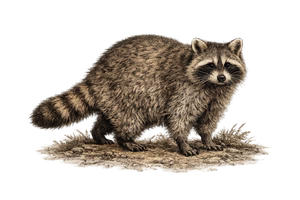
Raccoon scat can be larger and more tubular than the small pellets left by many herbivores. Raccoons are omnivores, so their droppings may contain recognizable food remains such as seeds or other undigested material.
SKUNK
Skunk scat can vary considerably depending on what the animal has been eating. Look around gardens, lawns and areas where the animal may be searching for insects or other food.
FOX
Fox scat is often tubular and may contain visible hair, bones, seeds or other remains depending on its diet. It may be found along trails, paths or other areas used regularly by the animal.
COYOTE
Coyote scat can resemble fox or domestic dog droppings. It may contain hair, bones or other remains and is frequently associated with travel routes.
OPOSSUM
Opossum scat can be relatively large and variable in appearance because of their diverse diet. Look for additional evidence such as tracks or nighttime feeding activity.
DEER
Deer commonly leave groups of small pellets. Their appearance can vary depending on diet and season, so location and other evidence should also be considered.
WHAT IS IN THE SCAT?
You may find:
- Seeds or berries
- Grass or plant material
- Hair
- Feathers
- Insect remains
- Small pieces of bone
- Shells or other food material
An animal's diet changes throughout the year, so scat won't always look exactly the same. What you find in spring may look very different from what you find in late summer or fall.
WHERE DID YOU FIND IT?
Location matters.
In the garden:
Could indicate an animal feeding nearby.
Near a burrow:
May indicate an animal occupying or regularly using the area.
Along a fence line:
Could indicate a regular travel route.
Under a deck or shed:
May indicate a protected resting or denning area.
Under a bird feeder:
Small mammals and other wildlife may be taking advantage of spilled seed.
On a lawn:
Look for accompanying tracks, digging or feeding damage.
DON'T IDENTIFY SCAT BY APPEARANCE ALONE
Several animals can leave droppings that look remarkably similar. Diet, weather, age of the scat and the animal's size can all affect its appearance.
That's why scat should be treated as one piece of evidence, not the entire answer.
Combine it with:
SCAT + TRACKS + DAMAGE + LOCATION + TIME OF ACTIVITY = A BETTER IDENTIFICATION
For example, droppings beside a large burrow mean something different when you also find freshly clipped vegetation around a garden. Droppings containing hair along a regularly used trail provide a different set of clues than small pellets beneath a bird feeder.
SAFETY FIRST
Never handle animal scat with bare hands. Avoid disturbing it unnecessarily, keep children and pets away from contaminated areas, and use appropriate protective measures when cleaning wildlife feces. If you are dealing with a large accumulation of droppings or are unsure how to safely clean an area, consider contacting a qualified wildlife-control professional.
BECOME A WILDLIFE DETECTIVE
You don't always have to see the animal to know that something is visiting your property.
Tracks tell you where it went.
Damage tells you what it did.
Scat can tell you what it may have been eating.
Put those clues together and you can begin to understand what's happening around your yard, garden or homestead.
Backyard Baits® was developed by people who understand that successful animal control starts with understanding the animal. Before selecting an attractant or control method, identify the problem, recognize the signs, understand the animal's habits, find the source and determine the appropriate solution.
Don't just clean up the evidence. Learn from it. Find the scat. Study the clues. Identify the animal. Find the source. Then choose the appropriate bait and control method.